WHAT YOU NEED TO KNOW
- Olivia Lutfallah’s simulation shows a simple kitchen chore expanding into about seven interconnected tasks.
- The video depicts distraction, forgetfulness, negative internal thoughts and the stress created by an increasing mental workload.
- Viewers with ADHD said the simulation reflected their experiences and helped communicate struggles that others may not understand.
- Lutfallah uses social media to educate people about ADHD, reduce stigma and encourage greater compassion.
An online simulation by Canada based content creator Olivia Lutfallah is drawing powerful reactions for showing how attention deficit hyperactivity disorder can transform an ordinary household chore into a crowded chain of competing demands.
Viewers with ADHD say the video captures an experience that can be difficult to explain to others.
Lutfallah says she was diagnosed with ADHD when she was about seven years old.
Her YouTube video focuses on a simple attempt to find something to eat and clean the kitchen, but distractions and newly discovered chores quickly complicate that plan.
According to the NHS, ADHD often involves difficulty concentrating, high energy levels and forgetfulness, with symptoms usually appearing during childhood.
eported symptoms also include impulsiveness, restlessness and problems with completing tasks.
Organisation, following instructions and managing time can also be difficult for people with the condition.
More adults are now reporting symptoms, while ADHD diagnoses in the UK increased by 4.2% between 2014 and 2023/24.
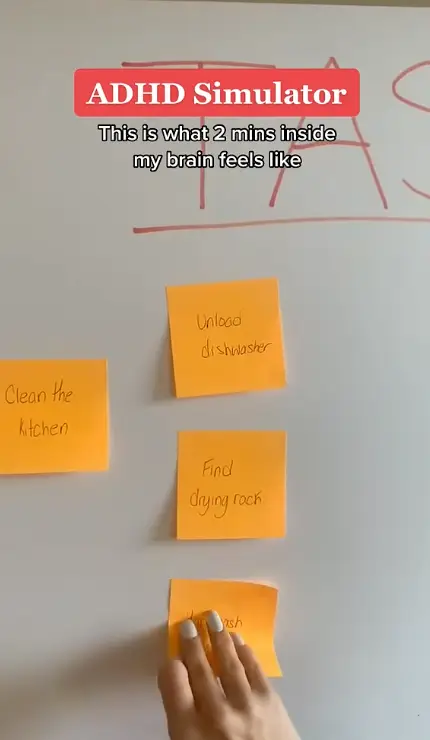
In Lutfallah’s simulation, the initial objective appears straightforward. She wants to get something to eat and clean the kitchen, yet almost every step reveals another unfinished job demanding her attention.
When she begins dealing with the dishes, she discovers that the dishwasher was never turned on.
That discovery interrupts the original task and creates another responsibility to remember and complete.
She then feels compelled to dry the rack, but she cannot immediately use it because the counter needs to be cleared first.
The kitchen has already become a web of connected chores rather than one manageable assignment.
Clearing the counter draws her attention to the messy cabinets. Instead of moving smoothly through the initial job, she is prompted to begin cleaning those out as well.
The simulation also depicts negative internal thoughts accompanying the accumulating work. When Lutfallah cannot find something or forgets a task, she calls herself irresponsible, adding frustration and stress to the growing mental workload.
By the end of the video, the apparently simple job of cleaning the kitchen has expanded into about seven interconnected tasks.

The simulation shows how the number of demands can grow before the first objective has been completed.
The portrayal prompted emotional responses from viewers who recognised their own experiences in the sequence.
MORE NEWS: YouTube Stars ‘Squirmy and Grubs’ Shatter Harmful Myths About Disability and Intimacy [WATCH]
One person commented, "This made me cry, thinking, wait…everyone else doesn’t think about a million things at once too."
Another response read, "I actually CRIED watching this. I REALLY wish people without ADHD would see this so they’d understand what we go through." The comment reflected the wider desire among viewers to have the condition better understood.
A third viewer captured the difficulty of choosing where to begin once responsibilities have accumulated, writing, "7 tasks and you don't know which one to start with. I feel you."
Lutfallah has said that she often felt misunderstood while growing up because people did not always recognise how ADHD affected her. One teacher refused to give her additional time for assignments because she was earning good grades.
Lutfallah explained that ADHD did not affect her intelligence. Instead, it made organising, focusing on and completing tasks more difficult, despite her academic performance.
She challenged the teacher’s understanding of the condition, and the teacher eventually apologised. The teacher told her, “Thank you for educating me. So I don’t make that mistake again.”
By the time Lutfallah entered college and began studying biology, she remained dissatisfied with how poorly people understood ADHD. She responded by launching a TikTok page dedicated entirely to the subject.
Her goal is to educate others, reduce stigma and encourage greater compassion for people living with ADHD.
The kitchen simulation advances that effort by turning an internal struggle into a visible sequence that viewers can follow.
WATCH BELOW:
Join the Discussion
COMMENTS POLICY: We have no tolerance for messages of violence, racism, vulgarity, obscenity or other such discourteous behavior. Thank you for contributing to a respectful and useful online dialogue.