WHAT YOU NEED TO KNOW
- Margaret Hamilton, whose software helped guide NASA’s Apollo astronauts to the moon, died at 90.
- At MIT, Hamilton led 100 engineers who designed software for NASA’s Apollo missions.
- Her software helped Apollo 11 continue safely during a critical computer incident three minutes before the lunar landing.
- Hamilton received the Presidential Medal of Freedom in 2016 and NASA’s Exceptional Space Act Award in 2003.
Margaret Hamilton, the groundbreaking researcher whose software helped guide NASA’s Apollo astronauts to the moon, has died at 90. Her work helped secure a defining victory in the 20th century space race while establishing software engineering as a professional practice.
The Massachusetts Institute of Technology, where Hamilton once worked, confirmed her death in a post from its department of aeronautics and astronautics. MIT reported that she died September 30, but it did not disclose the cause.
Hamilton joined MIT in 1959 and remained there until the middle of the 1970s. During that period, she managed the Software Engineering Division of the MIT Instrumentation Laboratory, which received a NASA contract in 1961.
She ultimately led a team of 100 engineers that designed the software used to guide NASA’s Apollo missions. The work placed Hamilton at the center of one of the century’s most consequential technological achievements.
Hamilton is also credited as one of the founders of software engineering, a term she popularized. Her efforts helped establish the emerging field as a recognized professional practice at a time when it remained in its infancy.
“To say Margaret Hamilton was a pioneer — to say she was ahead of her time — would be a dramatic understatement,” said Olivier de Weck, the Apollo Program Professor and interim head of the MIT Department Aeronautics and Astronautics, in a statement.
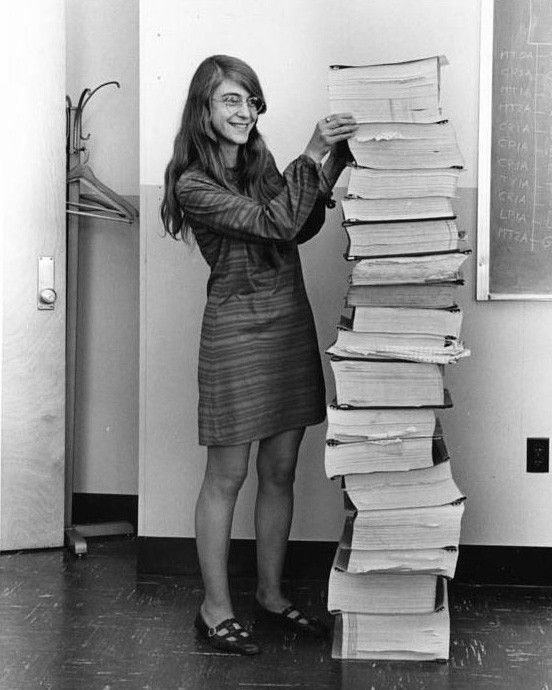
“She was a software engineer at a time when that field was in its infancy, and she not only developed advanced code herself but also led a team in using that nascent technology to develop one of the most complex systems humanity had ever achieved,” de Weck said.
Hamilton helped develop critical onboard software for the command modules and lunar landers used during the Apollo flights. She is credited with making those systems more robust and resistant to accidents.
One frequently cited safeguard was known as “the Lauren error,” named for Hamilton’s daughter. The problem emerged when the then 4 year old Lauren was playing with an Apollo command module simulator and caused the simulation to crash.
Hamilton later recalled that her daughter liked to play astronaut after watching simulations involving the software, hardware and astronaut. The unexpected crash showed Hamilton how a similar mistake could create far more serious consequences during a mission in space.
In response, Hamilton programmed backstops designed to prevent an astronaut from encountering the same problem during flight. That focus on anticipating errors became one of the defining features of her work on Apollo’s software.
NASA identified a dramatic example from the 1969 Apollo 11 mission. Just three minutes before the first touchdown on the lunar surface, Hamilton’s software overrode an erroneous attempt to shift the flight computer’s primary processing to a radar system.
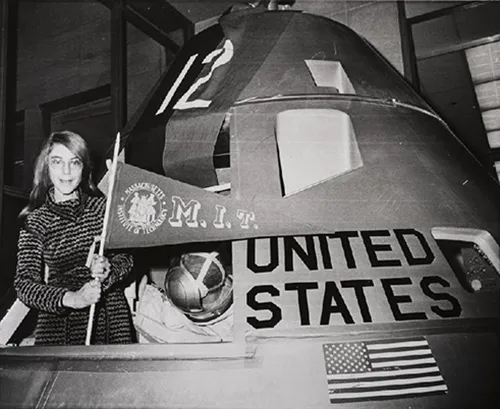
The software’s intervention “permitted the mission to safely continue,” NASA said. The episode demonstrated how the systems developed by Hamilton and her team could protect a mission at a critical moment.
After the Apollo work, the MIT Instrumentation Laboratory was spun off as the Charles Stark Draper Laboratory, now known as Draper Laboratory. Hamilton did not join the organization and instead left to establish her own company.
Draper CEO Jerry Wohletz said Hamilton left an “indelible mark.” He said her leadership and contributions helped ensure the Apollo astronauts landed safely on the lunar surface and returned home safely.
President Barack Obama awarded Hamilton the Presidential Medal of Freedom in 2016 for her contributions to science and space travel. She had also received NASA’s Exceptional Space Act Award in 2003.
Paul Curto, the technologist who nominated her for the NASA honor, said he was surprised she had never been formally recognized for her groundbreaking work. He said her ideas involving asynchronous software, priority scheduling, testing and decision capability became the foundation for highly reliable software design.
Hamilton was born in Paoli, Indiana, in 1936, according to MIT. She studied at the University of Michigan before earning a mathematics degree from Earlham College in Indiana, then took a position at MIT while her husband studied law at Harvard.
Join the Discussion
COMMENTS POLICY: We have no tolerance for messages of violence, racism, vulgarity, obscenity or other such discourteous behavior. Thank you for contributing to a respectful and useful online dialogue.